


Ready to accelerate your behavior and neuroscience research?
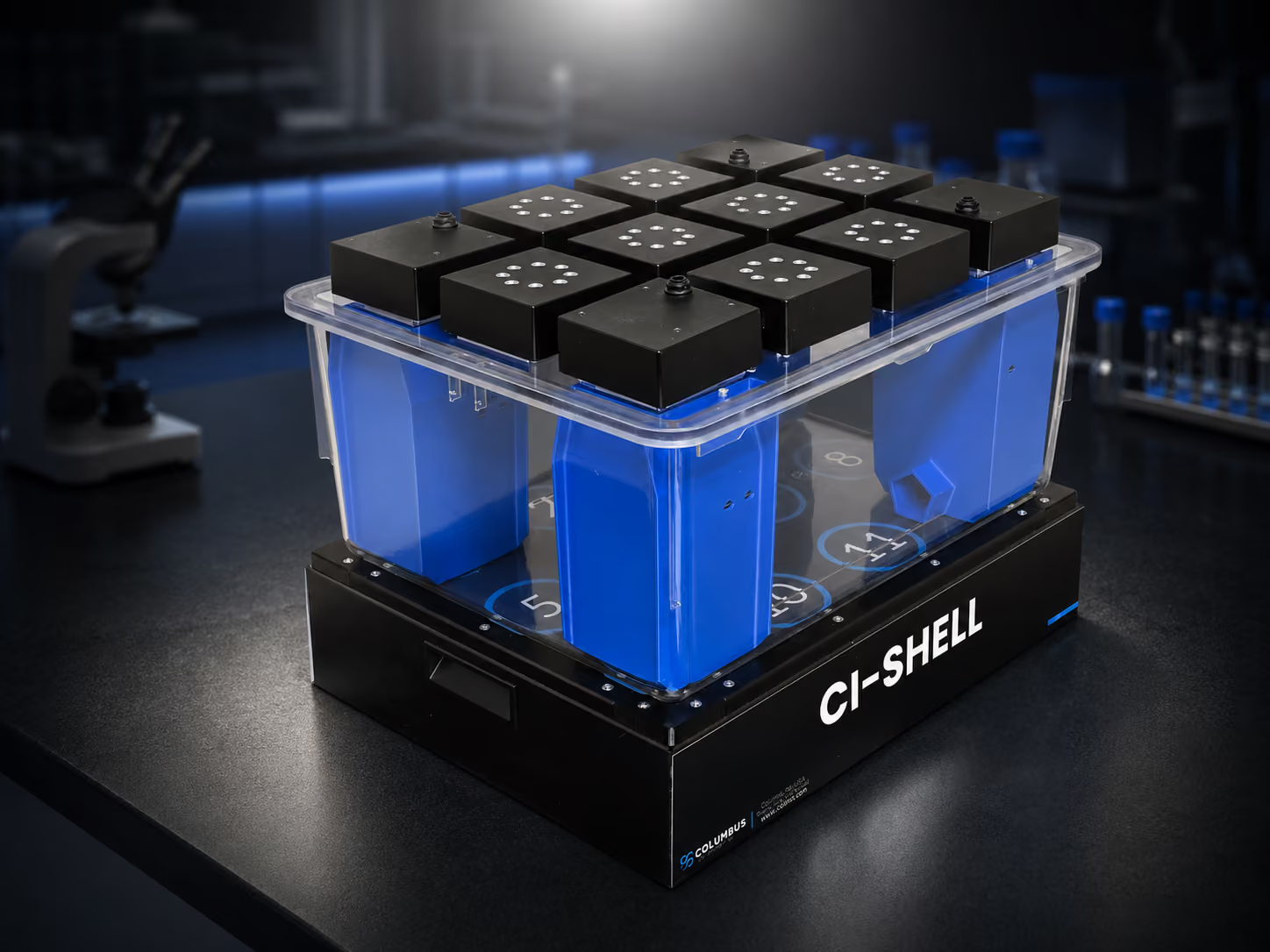
All set in more natural and socially relevant housing conditions to provide a flexible platform for long-term behavioral studies while minimizing animal disruption and simplifying data collection.
- Controlled social home environments
- Continuous activity and behavioral monitoring
- Designed for group-housed rodent studies
- Supports long-term experiments with minimal disruption
- Flexible configurations for different research applications
- Helps create more naturalistic housing conditions
- Easy-to-use monitoring and data collection systems
- Food & Water Consumption:
Customize the perimeters of your experiment and choose one as a reward; use them interchangeably- unique to CI-SHELL.
- RFID Tracking:
RFID implants work with antenna baseplates to identify subjects entering each conditioning corner for RFID mouse activity monitoring. Only CI-SHELL can obtain generalized positional information in the social area of the cage.
- Access Control:
Limit access to certain programmed conditioning corners.
- Electrical Stimulus & Air Puff Stimulus:
Choose between two types of stimuli. Program them directly in the CI-Link software; available only in CI-SHELL.
- LED:
Program any light color as a conditioned stimulus to help subjects associate that color with a particular action, such as gaining access to a reward.
- Software Individualization:
Set up conditioning corners on a per-subject basis using CI-Link software.


















.png)
.png)

Fields of study, clinical goals, and specific neurological conditions.
Neuroscience
- Brain and Behavior Research
- Neurobehavioral Research Animals
- Preclinical Neuro Research / Translational Neuroscience Research
- Behavioral Neuroscience Research
Disease Models
- Pre-Clinical Alzheimer's Research
- Pre-Clinical Anxiety Research / Pre-Clinical Anxiety
- Testing Addiction Research
.svg)
Assess brain function related to memory, decision-making, flexibility, and spatial awareness.
Learning & Executive Function
- Animal Behavior Analysis
- Cognitive Learning and Memory Research in Rodents (Mouse/ Mice/ Rodent Cognitive Learning Environment)
- Attention Set Shifting Task
- Reversal Learning / Reversal Learning Task (Mouse / Mice)
Spatial Learning & Memory Tests
- Pre-Clinical Spatial Learning
- Operant Conditioning
- Place Preference (Often Used in Addiction and Reward Research)

Monitor how rodents interact with one another, share social cues, or learn from peers.
- Social Interaction Tracking Rodent / Mice Social Testing
- Mice Social Conditioning
- Mice Social Food Behavior / Mice Social Food Preference
- Monitor Spatial Positioning Between Mice
- Assess Social Influences on Food Preference and Consumption Behavior
- Evaluate Social Hierarchy and Dominance Relationships Within Mouse Groups

Collect continuous, long-term data without human interference using the latest hardware, software, and tracking technology.
Home Cage Technologies
- Behavioral Phenotyping Systems / Behavioral Phenotyping Equipment
- Rodent Metabolic Phenotyping
- Automated Home Cage Monitoring / Social Home Cage Monitoring
- RFID Mouse Activity Monitoring
- Automated Mouse Consumption Monitoring / Automated Rodent Feeding System Cost
Features / Specifications

- Configure each conditioning corner to be either a food or a water reward
- Continuously monitor reward consumption, record both the amount consumed and the timing of each event
- Interchange the food and water reward modules within each conditioning corner
- Each conditioning corner has automated access-control doors for food and water rewards
- Access is programmable on an individual animal basis to support a variety of learning, preference, and behavioral paradigms

- Program each conditioning corner with three independent LEDs
- Configure the LEDs to display any RGB color
.svg)
- Identify subjects using subcutaneous RFID microchips that can be implanted without anesthesia
- Track subject location within the social area and conditioning corners using an integrated RFID antenna array within the CI-SHELL baseplate to communicate with each microchip wirelessly
- Program either an electrical or an air-puff stimulus for behavioral conditioning studies
- Select the electrical stimulus intensity within the CI-Link software
- Configure stimulus delivery independently for each subject and conditioning corner
- 19'L x 15'W x 15'H
- 16.78 kg
Key Maintenance Information
- Implant without anesthesia
- Use the supplied identification wand to track subjects implanted with RFID microchips to prevent mismatching and track subjects between studies
- The stainless-steel metalwork and base cage are machine washable for easy cleaning
- Other components are removable for separate hand washing
Frequently Asked Questions - FAQs
When a subject moves over an RFID antenna within the baseplate, the system records its position. These positional data are used to generate a heatmap for the subject.
Each animal is implanted with a subcutaneous RFID microchip containing a unique identification number. The microchip can be implanted without anesthesia, allowing the system to automatically identify individual animals throughout the study.
When a subject enters a conditioning corner, all reward-consumption events are associated with that animal's unique RFID identifier. This allows individual food and water intake data to be collected in the group setting.
Yes, different food types can be placed in separate conditioning corners, allowing researchers to study food preference and dietary choice.
CI-SHELL is highly configurable and supports a variety of behavioral applications, including:
- Operant conditioning
- Reward-based learning
- Preference testing
- Circadian behavior studies
- Social interaction research
- Feeding motivation studies
- Cognitive flexibility tasks
- Resource competition studies
- Environmental enrichment research
Data is collected continuously throughout the study. CI-SHELL is designed as a home-cage environment, enabling long-term monitoring with minimal disruption to natural animal behavior.
CI-SHELL is currently designed for mice but may be adaptable for other small laboratory animal species depending on study requirements.
No, CI-SHELL's RFID system is designed to operate through standard laboratory bedding materials. Normal bedding levels do not interfere with RFID communication or animal identification.
Yes, the system continuously records animal location, allowing researchers to evaluate social behaviors within the cage.
Yes, access-control doors can be programmed for individual animals, allowing researchers to control which subjects can access specific food, water, or conditioning areas.
CI-SHELL is designed as a home cage for long-term studies, depending on the study’s needs.
Yes, each conditioning corner contains programmable RGB LEDs that can be used as visual cues for learning and discrimination experiments.